
Art / Therapy
In 2006, I was pretty depressed. I had just premiered Digging in the Dark, a show that explored the deep Earth with geophysicists and geologists. I was comparing the layers of the planet to the layers of human consciousness, wondering why we understood outer space better than the world beneath our feet. And privately, I was trying to understand what I was missing—why it felt like my career was failing.
My New York season had been derailed by a shady theater owner who told me “yes, we have AC,” but conveniently left out the part where it couldn’t run while the stage lights were on. After I’d paid three weeks of rent and loaded the show in, he informed me that the audience would sit in blistering heat while my dancers risked slipping in their own sweat. It was the only show I have ever closed early—for safety, and honestly, for our sanity.
The place we were subletting came with a warning: if the neighbors saw anyone entering besides us, they would “tell.” We were being monitored by a violinist—another performer—who seemed to have appointed herself building police. Coming from San Francisco, land of please bring your friends, the suspicion felt cruel and absurd. And then there were cockroaches. So we told my partner’s mom—who had flown across the country to see the show—that she couldn’t stay with us. She had to go to a hotel. Wow. I hate New York sometimes.
That summer sunk me. I felt lost. I hated my work. The show was deep and painful, and so was everything around it.
And yet—one thing from that period still glows for me: the Mantle duet.
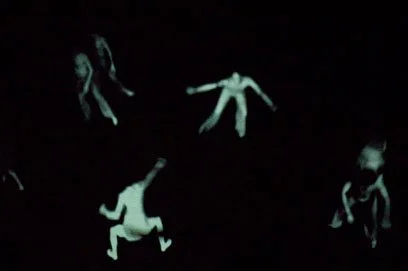
The Mantle is a love duet about losing and finding your partner over and over again in the dark. We used infrared lights and cameras to transform the stage from pitch black to a glowing red field. I also designed the aerial orb sculpture for the show—the “inner core” of both the Earth and our beings. It begins packed with six performers, who exit one by one until only empty space remains.
The real inner core of the Earth is so hot it should be liquid, but pressure forces it into solidity. It’s constantly vibrating, its exact center point shifting every moment as one cell replaces another. There is no fixed center for long—it is always in flux. On the deepest level, so are we. We are vibrating, structured emptiness pretending to be stable.
Sometimes you have to bottom out to realize you need to change.
I decided I needed a therapist. I didn’t know what needed to shift, only that something had to. I asked her to watch videos of my past works—to help me understand the messages I had been speaking through my art, even when I couldn’t hear myself.
She admitted she wasn’t confident “reading” art, but she would try. She came to the premiere of Biome, and she looked at some of the images I was creating with photographers as a form of personal processing. But ultimately, she didn’t feel comfortable working with me on the level of creative output. So we did traditional talk therapy. Progress was made—but not through the portal that mattered most to me: the creative process itself.
If we had been able to work through my images, my movement, my inner symbolic world, the work would have moved faster, deeper, more honestly. I would have felt profoundly understood.
Creative Journey is the answer to that unmet need.
It is the process I wish I had been given—creative problem solving and guided art-making, not for sale but for self. A dialogue between the inner world and the outer expression. As a parent, you want to give your child what you needed most. As an artist, I want to give both artists and non-artists the reflection, witnessing, and meaning-making through their own living art project that I needed back then.
There is a door to your deeper wisdom. You find it when you free-write, sketch, smear paint, or knead clay. Psychedelics don’t just open the door—they sweep you through it. On the other side, we can finally hear ourselves clearly. We learn that we already know what is necessary and true.
Then all that remains is the courage to act on it.